
How to Register a Homemade Trailer in Massachusetts: The Ins, Outs & What You Need to Know


Built your own trailer in Massachusetts? Before you hook it up and hit the road, you need to get it properly registered.

Homemade trailers are a little different from buying a new trailer from a dealer. There may be no manufacturer’s certificate of origin, no traditional VIN, and—depending on the trailer’s weight—no title.

The good news? You can register a homemade trailer in Massachusetts.

The process just depends on how the trailer is built and, most importantly, its gross vehicle weight rating (GVWR).

Here’s what Massachusetts trailer owners need to know.

First: How much does the trailer weigh?

This is the most important question.

Massachusetts generally divides trailers into two categories:

Homemade trailer weighing 3,000 pounds or less

If your homemade trailer has a GVWR of 3,000 pounds or less, it does not require a Massachusetts certificate of title.

Instead, it can generally be registered as a trailer without going through the title process. Massachusetts RMV materials specifically provide for registration of homemade trailers without a conventional VIN, using a pseudo-VIN assigned by the RMV system.

Homemade trailer over 3,000 pounds

This is where things get more complicated.

A homemade trailer with a GVWR over 3,000 pounds must be titled, and Massachusetts requires the trailer to obtain a Massachusetts-assigned VIN.

The RMV specifically lists homemade trailers over 3,000 pounds among the vehicles eligible for a Massachusetts-assigned VIN.

The State Police inspect the trailer as part of the VIN assignment process. The assigned VIN begins with “MA” followed by five digits and is affixed to the trailer.

What paperwork do you need for a homemade trailer?

Here’s the part that catches many do-it-yourself trailer builders by surprise.

If you built the trailer yourself, you don’t have a traditional dealer invoice showing what you paid for it.

Massachusetts RMV guidance says the owner should provide a detailed, handwritten statement of the costs incurred in constructing the trailer.

That statement should include the materials and costs that went into building it. Receipts for materials can also be submitted as supporting documentation.

The statement must be:

  • Detailed
  • Signed
  • Dated
  • Dated as of when the trailer was completed and road-ready

It does not have to be notarized. The completion date is also used to determine the trailer’s model year.

Why does the RMV want to know what you spent?

Because Massachusetts uses the value of the materials and construction costs to determine the applicable sales tax.

In other words, don’t assume that because you built it yourself, there is no sales tax issue.

Keep those receipts!

What about the VIN?

This depends on the trailer.

Trailer 3,000 pounds or less

A homemade trailer under the title threshold may not have a traditional VIN. Massachusetts has a process for these trailers to be registered using an RMV-generated pseudo-VIN. The RMV’s EVR guidance specifically identifies homemade trailers without VINs and provides for the system to create a pseudo-VIN for registration purposes.

Trailer over 3,000 pounds

You’ll need a Massachusetts-assigned VIN.

The process involves submitting the appropriate VIN application and supporting documentation to the RMV and having the trailer inspected by the Massachusetts State Police.

Don’t confuse this with simply walking into an inspection station and asking for a VIN. The assigned-VIN process is a separate RMV/State Police procedure.

Do I need a title?

Here’s the simple rule:

3,000 pounds or less: No Massachusetts title is required.

Over 3,000 pounds: Yes. A certificate of title is required.

The current Massachusetts title fee is $75, in addition to applicable taxes and registration fees.

Getting the trailer registered

Once you’ve determined which category your trailer falls into and gathered the necessary documentation, you’ll need a Registration and Title Application (RTA).

A Massachusetts insurance agent can complete the insurance portion of the application and process the registration through the appropriate RMV system or help you determine what needs to be submitted to the RMV. Massachusetts specifically encourages customers to use participating insurance agents and other RMV business partners for registration transactions.

For a homemade trailer over 3,000 pounds, however, make sure the VIN/title requirements have been satisfied before expecting a routine registration transaction to go through.

Don’t forget the trailer’s equipment

Registering a homemade trailer isn’t the same thing as saying the trailer is automatically legal or safe to operate.

Massachusetts law allows the Registrar to refuse or suspend registration if a motor vehicle or trailer is unsafe, improperly equipped, or otherwise unfit to operate.

Before putting your homemade trailer on the road, make sure it is properly equipped and roadworthy, including the appropriate:

  • Lights
  • Brake and electrical components
  • Tires and wheels
  • Safety chains
  • Hitch/coupler
  • Reflectors
  • Fenders or other required equipment
  • Load securement

The exact requirements can depend on the type, size, weight and use of the trailer.

Does a homemade trailer need an inspection?

This is another area where how you use the trailer matters.

Massachusetts has an annual safety inspection program covering motor vehicles, trailers, semi-trailers and converter dollies.

The RMV also specifically notes that trailers used commercially, regardless of registered weight, must pass an annual safety inspection.

So don’t assume that because your trailer is homemade—or because it’s a small personal-use trailer—it is automatically exempt from every inspection requirement.

If the trailer will be used commercially, this becomes particularly important.

What about insurance?

This is where you should talk to your insurance agent before you build the trailer, not after you’ve registered it.

Trailer coverage can depend on:

  • Whether the trailer is personally or commercially used
  • What the trailer is designed to carry
  • Its value
  • Its weight
  • Whether it is used with a personal or commercial vehicle
  • Whether it is a utility, boat, cargo, or specialty trailer

Some personal auto policies provide certain coverage for trailers, but don’t assume your homemade trailer is automatically covered for everything simply because your automobile is insured.

For example, liability coverage and physical-damage coverage are two different questions.

If you’ve put several thousand dollars into building a custom trailer, you should specifically ask your insurance agent how the trailer itself is covered.

A common mistake: “I built it, so I don’t need paperwork.”

Unfortunately, that’s not how Massachusetts works.

Even though you built the trailer yourself, once you intend to operate it on Massachusetts public roads, you still have to satisfy the Commonwealth’s registration requirements.

And if the trailer is over 3,000 pounds, the VIN and title requirements become substantially more involved.

Homemade Trailer Registration Checklist

Before heading to the RMV, make sure you’ve worked through this list:

☐ Determine the trailer’s GVWR

☐ Determine whether the trailer is over or under 3,000 pounds

☐ Gather receipts for materials and components

☐ Prepare a detailed statement of construction costs

☐ Determine whether a Massachusetts-assigned VIN is required

☐ Complete the appropriate RTA paperwork

☐ Obtain the appropriate insurance

☐ Complete the title process if the trailer is over 3,000 pounds

☐ Pay applicable sales tax, title and registration fees

☐ Make sure the trailer meets Massachusetts equipment and safety requirements

☐ Determine whether annual inspection requirements apply

The Bottom Line

Building your own trailer can save money and let you create exactly what you need—but Massachusetts doesn’t treat a homemade trailer exactly like a factory-built trailer.

The 3,000-pound threshold is the big dividing line:

3,000 pounds or less: generally no title, and a homemade trailer can be registered through the RMV’s registration process.

Over 3,000 pounds: title required, Massachusetts-assigned VIN required, and State Police inspection is part of the VIN process.

And regardless of weight, don’t overlook the insurance side.

At Johnson & Rohan Insurance, we’re happy to help Massachusetts trailer owners figure out the insurance and registration requirements before they get stuck at the RMV.

This article is intended as general information and is not legal advice. Massachusetts RMV requirements can change. For unusual, custom-built or commercial trailers, we recommend confirming the current requirements with the Massachusetts RMV before beginning the registration process.
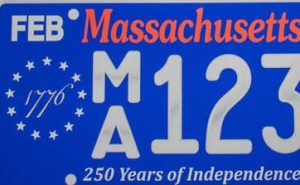
MA 1776 “250” Plates …

The new, MA 1776 “250” plates have generated quite the buzz. We’ve had numerous clients trade in their old plates to get these new, passenger special series (PAS) plates.
The cost is $100 every 2 years (vs. regular, passenger plates which are $60 every 2 years).
Surprisingly, or maybe not, the plates are in such high demand that the RMV tells us they’ve run out of plates and it’s going to take 8 – 10 weeks for them to be issued.
In the meantime, however, the RMV will issue a paper, temporary plate until consumers receive their new plates.
We asked AI if it’s true that the RMV has run out of new 1776 “250” plates:
Yes, due to unexpectedly high demand, the Massachusetts RMV is currently experiencing an 8–10 week delivery delay for the new MA-250 special license plates. The information you received from the RMV is accurate. 
Here is what you need to know about the delay:
  • Official notice: The RMV has issued a training update for dealerships and other partners to inform customers of the delay. An email was also sent to recent customers who ordered the plates.
  • Temporary plates: Customers who do not have existing plates when they order will be issued temporary plates to use while they wait for their permanent ones. If your temporary plates expire before the new ones arrive, you can renew them online.
  • High demand: The plates were made available on May 22, 2025, and the surge in orders has led to a production and delivery backlog. 

Mass Registry of Motor Vehicles Contact Info


Below please find Mass Registry of Motor Vehicles contact info:

if you have RMV questions or have technical issues.

  • for a manual and other information click on: https://atlas.massrmv.com/IPMProgram.aspx.  If the user clicks on Training and Support, they will get to the “IPM eServices Reference Guide for Insurance Industry Users”
  • Have a Payment Link Resent/Issue:
  • Email RMVRegDropoff@state.ma.us Include:
  • Drop Off Date:
    • RMV Drop Off Location:
    • Name of Runner Service (if applicable):
    • Name of your agency/business:
  • VIN #(s):
  • Email address for payment:
  • Special Plate Department – 857-368-8031

for issues with duplicate/replacement plates

to find out about a tin plate not received in mail

to order special plates.

  • Section 5 Department – 857-368-8030
  1. Dealer, Repair, Owner Contractor, Transporter or Farm Plates
  2. Question regarding these plate types
  3. Questions on Renewals
  1. Contact the IRP department with Apportioned plate Questions
  2. Contact regarding Apportioned Renewals
  • Out of State Citations Department – 857-368-8200
  1. Customers can now clear online OOS Reciprocal Suspensions

This form can be used by NON-EVR Agents for correction.

  • Consumers that use the Drop Off Center that have not received a payment link or call to pick up work can send an email here:  RMVRegDropoff@state.ma.us

They need to include:

Their Name

Branch Location

Date of Drop Off

Transaction Type

Email Address

If you are locked out you can call security to be reset

If you have a customer that wants to file a complaint for privacy violations, they can call security.

  • Title Department – 857-368-8050

If you have a customer that is showing a title has not been mailed, is under review or exam, you can contact titles to see if the title can be sent.  Make sure that the mailing address is correct in the customer ATLAS account.

  • MAIA Registry Procedures Manual

You may also want to consider using the RPM that is key word searchable for your RMV questions.  Here is a link to the MAIA RPM:   https://massagent.com/MassAgentSite/Agency-Tools/AgencyTools/Registry-Procedures-Manual.aspx

  • Registration and Title Application Instruction Guide

Here is a guide on what sections of the RTA to complete for the transaction being processed:  https://www.mass.gov/doc/registration-and-title-application-instruction-guide/download

  • Massachusetts Department of Revenue 800-392-6089

If you need information on sales tax values

If you need to determine the amounts of Penalties and Interest on motor vehicle sales tax.

For any questions:  MRB-DL-FTP@dot.state.ma.us  .

MA RMV Low Number Plate Lottery

The Massachusetts Registry of Motor Vehicles (RMV) recently announced that applications for the 2023 Low Number Plate Lottery will be accepted beginning on Friday, June 30, 2023, at 7:30 p.m.

Applying for a Low Number Plate

  • From the myRMV Online Service Center, scroll down to the “Plates” section on the left side, and select the “Apply for Plate Lottery” button.
    • Applicants must apply by Thursday, August 31, 2023, 5:00 p.m. and, if selected for a low number plate, the winner will be notified after the drawing takes place which will be no later than September 15, 2023.
    • There is no fee to apply to the lottery. However, winning applicants are responsible for standard license plates and registration fees.

This year, there are 191 plates available through the low plate lottery including plate numbers: 1999, 1100, 4004, and 4400.

Lottery Rules and Eligibility Requirements

  • Only one entry per applicant will be accepted, regardless of the number of active registrations the applicant has.
  • An applicant must be a Massachusetts resident with a currently active, registered, and insured passenger vehicle.
  • Companies/corporations may not apply.
  • MassDOT (Registry of Motor Vehicles, Highway, Mass Transit, and Aeronautics) employees, including contract employees, and their immediate family members are not eligible. (“Immediate family member” refers to one’s parents, spouse, children, and brothers & sisters.)
  • Requests for specific plate numbers will not be honored. Eligible applicants will be considered for all plates listed. Plates will be awarded in the order in which they are listed on Mass.Gov/RMV.
  • An applicant’s registration and license cannot be in a non-renewal, suspended, or revoked status at the time of entry, the time of the drawing, or the time of the plate swap. As such, an applicant must not have any outstanding excise taxes, parking tickets, child support, warrants, or unpaid E-Z Pass/Pay by Plate violations.
  • Online entries will be accepted only and must be submitted by 5:00 p.m. on Thursday, August 31, 2023.
  • Lottery results will be available on the RMV website: Mass.Gov/RMV. By law, lottery winners must be announced by Friday, September 15, 2023.
  • All winners will be notified by mail with instructions on how to transfer their current registration to their new lottery plate. Winners will have until Friday, December 29, 2023, to swap their plates.
  • Unclaimed plates will be forfeited and awarded to alternate winners after Friday, December 29, 2023.
  • Plates will be registered to the winning applicant only. All plates remain the property of the RMV even after registration.
  • All information received, including names of all applicants and the list of winners, is subject to release in accordance with the Massachusetts Public Records Law.

Note

  • Customers are encouraged to visit the RMV’s website or follow @MassRMV on Twitter for upcoming details on the virtual low plate drawing.
  • A link to the lottery event will be made available leading up to the lottery. In addition, applicants will be sent a notification via email.
  • The lottery results will be posted on the RMV’s website.

Stay Connected! 

  • For the latest RMV updates and information, including for the Low Plate Lottery, follow the RMV on Twitter @MassRMV.

For the latest MassDOT news and information, including RMV updates, follow MassDOT on Twitter @MassDOT, Facebook, and Instagram.

Antique Plates

Antique Plates

What is an antique car or truck? Under MA antique license plate rules, an antique vehicle is a car manufactured at least 25 years ago, which is maintained for use in exhibitions, parades and other public events. If you are interested in Antique Plates there are certain rules to be aware of.

The Registry of Motor Vehicles designates antique plates as “restricted.” “Restricted to those vehicles over 25 years of age, restricted to test drives, movement of vehicles to and from repair locations, and public functions such as parades.”

Steps in the Massachusetts Registration Process

  • Fill out and submit an insurance company stamped, RTA form.
  • Submit previous, signed over, certificate of title.

Fees to Register an Antique Vehicle in Massachusetts

The Massachusetts Registry of Motor Vehicles requires original, signed over title, antique vehicle application, RTA form (Registration and Title Application) and check payable to the “RMV.” Costs should be: $75.00 for new MA title, $50.00 for plates and 6.25% sales tax.The Registry of Motor Vehicles charges an annual fee of $50.00 for antique plates. The also charge $50.00 for year of manufacture plates.

VEHICLES that qualify

  • Classic Cars
  • Hot Rods
  • Antique Cars
  • Modified Cars
  • Street Rods
  • Exotic Cars
  • Lowrider
  • Classic Motorcycles

Rules to follow

You can drive your car:

  • Holidays
  • Parades
  • Weekends

Your collectible car needs to be and must be stored inside in a secure locked garage or structure.

Insurance companies will not cover damage to antique vehicles done due to racing.

Antique plates application

New Hands-Free Electronics Device Law

New Hands-Free Electronics Device Law

New Hands-Free Electronics Device Law While Driving – It’s the Law

The new Hands-Free Electronics Device Law distracted driving law takes effect on Sunday, February 23.

This law is a significant change for drivers 18 and over and traffic enforcement as well. The new law (Chapter 122 of the Acts of 2019) prohibits operators of motor vehicles from using any mobile electronic device, including a cell phone, unless the device is used in hands-free mode.

Drivers 18 and over are:

  • Not permitted to hold or support any electronic device
  • Only permitted to touch devices to activate the hands-free mode, and can only enable when the device is installed or properly mounted to the windshield, dashboard, or center console
  • Not permitted to read or view text, images, or video displayed on a mobile electronic device; however, a driver may view a map generated by a navigation system or application on a mobile electronic device that is properly mounted

Drivers under 18 are not allowed to use any electronic devices. All device/phone use while driving is illegal, including use in hands-free mode.

Penalties for Violating the Hands-Free Law

  • 1st offense – $100 fine
  • 2nd offense – $250 fine, plus mandatory completion of a distracted driving educational program
  • 3rd and subsequent offenses – $500 fine, plus insurance surcharge and mandatory completion of distracted driving educational program

Operators may use a cell phone to call 911 to report an emergency. If possible, the operator should safely pull over and stop before calling 911.

More Info
Please visit Department of Transportation website for more details. We’ve also included a link to an informational brochure below, that we ask you to review, post, and share with your customers and colleagues.

Questions About New Hands-Free Electronics Device Law?
Contact MA Department of Transportation at RMVATLASSupport@dot.state.ma.us with any questions you may have.

New Registration and Title Application (RTA) and New Registrations

New Registration and Title Application (RTA)

The Massachusetts Registry of Motor Vehicles has announced that after December 12, 2019, they will no longer accept the familiar, triplicate RMV-1 and RMV-3 forms.

Replacing them is the new, single-copy: Registration and Title Application (RTA)

The RMV currently has a Registration and Title Application (referred to as an RMV-1) and a Registration and Title Amendment Form (referred to as an RMV-3). With ATLAS  Release 2, these two forms have been combined into one — the new Registration and Title Application (RTA). This new RTA form supports additional information the RMV will use in their business processes after ATLAS R2 implementation. Examples include the garage address, expanded sales and use tax information, slight changes to the vehicle description, and a general layout that follows the screen flow in the ATLAS system.

This updated form will be implemented as of November 12, 2019.  However, the RMV will continue to accept the old RMV-1 form as long as it was stamped and dated by an insurance company or agent prior to November 12, 2019.  Since the insurance stamp is valid for 30 calendar days, the last day for an old RMV-1 form to be accepted will be December 12, 2019.

NEW:  Certificate of Registration

With ATLAS Release 2, the Certificate of Registration will be changing to include the Change of Address for Residential, Mailing, and Garaging.