The Future of Insurance in Massachusetts: 2040

If you’ve noticed your insurance costs rising in recent years, you’re not alone.

Homeowners and drivers across Massachusetts are asking a simple question:

Are insurance prices going to keep going up—or is this temporary?

The short answer: insurance is entering a long-term shift driven by technology, construction costs, climate risk, and vehicle complexity.

Here’s what that means for the next 10–20 years.


Will Insurance Costs Go Up or Down?

In Massachusetts and across the U.S., most long-term projections point in one direction:

Insurance costs are expected to continue rising over the next 10–20 years.

This is not just a pricing trend—it’s driven by real-world cost increases, including:

  • Higher home rebuilding and repair costs
  • Increasingly advanced vehicle technology
  • More expensive medical and liability claims
  • Severe weather and climate-related losses
  • Labor shortages in construction and repair industries

When it costs more to repair or replace something, insurance must reflect that reality.


The Future of Auto Insurance: Safer Cars, Higher Repair Costs

Cars are becoming safer and more advanced, with features like:

  • Lane assist and collision avoidance systems
  • Electric vehicle (EV) platforms
  • Advanced onboard computers and sensors
  • Partial and full autonomous driving capabilities

While these features may reduce accidents, they significantly increase repair costs.

A simple bumper repair today may involve recalibrating multiple sensors and onboard systems.

Expected impact:

  • Fewer accidents overall
  • Higher cost per claim
  • More specialized repair networks
  • Continued upward pressure on premiums

Auto insurance will not disappear—it will evolve with vehicle technology.


Home Insurance in Massachusetts: Stronger Homes, Higher Replacement Costs

Homes are improving in durability and technology, including:

  • Fire-resistant building materials
  • Smart home monitoring systems
  • Leak detection and prevention technology
  • Energy-efficient construction standards

However, the most important factor in insurance pricing is still:

Rebuilding cost

In Massachusetts, construction and labor costs have risen significantly over the past decade, and that trend is expected to continue.

Expected impact:

  • More expensive claims when losses occur
  • Continued pressure on home insurance premiums
  • Increased importance of accurate replacement cost coverage

Even as homes become safer, they are also more expensive to rebuild.


Weather and Risk Trends in Massachusetts

While Massachusetts is not the highest-risk catastrophe state, insurers are increasingly factoring in:

  • Nor’easters and winter storm damage
  • Coastal exposure and storm surge risk
  • Freeze-thaw structural damage cycles
  • Increasing variability in seasonal weather patterns

Insurance pricing is influenced not just locally—but nationally.

Large-scale losses in other regions can impact pricing across the entire country.


How Technology Will Change Insurance

The biggest transformation may not be what we insure—but how insurance works.

Over the next two decades, we expect:

  • Faster claims processing powered by AI
  • More personalized pricing based on real-time data
  • Smart homes and vehicles communicating risk data
  • Fully digital policy management systems

Insurance will become more responsive, more automated, and more data-driven.

But human guidance will still matter—especially when decisions are complex or high-value.


What This Means for Massachusetts Consumers

Insurance is shifting from a simple purchase to an ongoing risk management strategy.

Consumers should expect:

  • More frequent policy reviews
  • Greater differences in coverage quality between carriers
  • Increased importance of proper coverage limits
  • Less focus on price alone—and more on protection

The goal is no longer just finding the cheapest policy.

It’s ensuring you are properly protected in a changing world.


Final Thoughts

Even as technology improves and homes and cars become more advanced, one truth remains:

Risk does not disappear—it evolves.

Insurance will continue to change alongside the world around it.

Our role as an independent agency is to help clients stay ahead of those changes—not react after the fact.

Because in the future, the most important question won’t be:

“How much does it cost?”

It will be:

“Am I properly protected for what comes next?”

Trusted Home & Auto Insurance in Lynnfield, MA

Lynnfield. MA

For over 30 years, Johnson & Rohan Insurance has proudly served the families and businesses of Lynnfield, Massachusetts. As a local, independent insurance agency, we understand the community—from MarketStreet Lynnfield to Town Hall, seasonal events, and neighborhood favorites. This local knowledge helps us provide personalized home insurance in Lynnfield and auto insurance near Lynnfield MA that fits your life and budget.

We represent over 30 top-rated insurance carriers, shopping across multiple companies to find the best coverage at the most competitive rates. Whether you need homeowner, condo, apartment, auto, or umbrella insurance, we focus on protecting what matters most to you.

At Johnson & Rohan, we treat our clients like family. From answering questions to guiding you through a claim, we make insurance simple and stress-free. That’s why so many Lynnfield residents trust us—and refer their neighbors—to keep their homes and vehicles protected.

If you’re looking for local insurance expertise in Lynnfield, MA, contact us today. We’re ready to provide coverage that fits your life, your home, and your budget.

Spring? Hopefully …

Spring has a way of sneaking up on us in Massachusetts. One day you’re stepping over snowbanks, the next you’re hearing birds again and noticing the sun sticking around a little longer each evening. This year, the first official day of spring—the vernal equinox—arrives on March 20. It’s a welcome milestone, but as any New Englander knows, it doesn’t mean winter is finished with us just yet.

March and April can be unpredictable. Warm afternoons can quickly give way to freezing nights, late snowstorms, heavy rain, and those classic freeze-thaw cycles that seem determined to test every part of your home. It’s a season of transition—and a good time to make sure your property is ready for whatever comes next.

A few simple steps now can help prevent headaches later:

Keep an eye on your roof and gutters.
Snow and ice may be melting, but that runoff has to go somewhere. Make sure gutters and downspouts are clear so water can flow away from your home. Ice dams and clogged gutters can lead to leaks just when you think you’re in the clear.

Watch for water around your foundation.
Melting snow combined with spring rains can saturate the ground quickly. Check that water is draining away from your foundation, and consider testing your sump pump if you have one. A small issue now can turn into a flooded basement fast.

Inspect for winter wear and tear.
Take a walk around your property. Look for cracked walkways, loose shingles, damaged siding, or anything that may have taken a beating over the winter months. Catching these early can prevent more costly repairs down the road.

Be cautious with early outdoor projects.
It’s tempting to jump into yard work or fire up equipment at the first sign of warmth. Just remember that the ground may still be soft, and temperatures can dip below freezing again. Proceed carefully to avoid damage to landscaping—or injuries.

Review your coverage.
Seasonal transitions are a good time to revisit your insurance policies. Whether it’s making sure your home is properly covered for water damage or confirming limits and deductibles still make sense, a quick review can bring peace of mind heading into the months ahead.

Spring in Massachusetts is a mixed bag—but that’s part of its charm. The days get brighter, the air feels lighter, and there’s a sense of renewal that’s hard to miss. Just don’t pack away the winter gear too quickly. Around here, we know better.

If you have questions about your home coverage or want to make sure you’re prepared for whatever this spring brings, we’re always here to help.

No Vacancy

Heads Up: Vacant Homes and Insurance – Why We Need to Know

Hey, it happens — tenants move out, you’re between renters, a home is being renovated, or maybe it’s just sitting on the market waiting for the right buyer. Life happens.

But here’s something a lot of people don’t realize: once a property sits empty for too long, your insurance coverage can change — sometimes drastically.

And if we don’t know the property is vacant, a claim could be denied. That’s a scary thought, but it’s avoidable.


Unoccupied vs. Vacant — There’s a Difference

Insurance companies care about the details:

  • Unoccupied: The home is furnished and utilities are on, but no one is living there.

  • Vacant: The home is mostly empty — furniture gone, utilities may be off, nobody living there.

Most policies have a vacancy rule — usually after 30 or 60 consecutive days, the insurer may limit coverage for theft, fire, water damage, vandalism, or even deny a claim completely.

Basically: an empty house is riskier, and insurers treat it that way.


Real-World Scenario

Imagine this:

A rental tenant moves out in January. You’re planning to rent it again in spring. The place sits empty for 75 days.

Then — boom — a pipe bursts. You file a claim.

If we weren’t told the house was vacant, the insurance company might deny the claim because it was empty too long. That’s not a “maybe” — it’s exactly how vacancy clauses work.


Why You Should Call Us

When a property becomes vacant or unoccupied, give us a call immediately. It takes just a few minutes, and we can:

  • Add a vacancy endorsement

  • Switch to a vacant dwelling policy if needed

  • Adjust coverage to keep you protected

It might cost a little more temporarily, but trust me — it’s way cheaper than an uncovered loss.


Even Short-Term Vacancies Count

Don’t assume a couple months is fine. This includes:

  • Homes between tenants

  • Seasonal or vacation homes

  • Properties being renovated

  • Homes listed for sale

  • Inherited or probate properties

If it’s empty, we need to know.


Bottom Line

We’re here to protect you — but insurance policies are contracts, and vacancy rules are real.

So, if a property is going to be unoccupied or vacant, please call us. A quick phone call now can save you from a big headache later.

Ice Dams Are Back: What Massachusetts Homeowners Need to Know

After nearly two feet of snow across Massachusetts, ice dams are making an unwelcome return. For anyone who lived through the winter of 2015, this feels familiar—and not in a good way. As snow piles up on roofs and temperatures swing above and below freezing, water has nowhere to go… except into your house.

And yes—our phones are already ringing.

What Is an Ice Dam?

An ice dam forms when:

  • Heat escapes from your home and melts snow on the roof

  • Melted water runs down toward the colder roof edge

  • The water refreezes at the eaves, forming a dam

  • Additional melting snow backs up behind it

That backed-up water can then:

  • Seep under shingles

  • Enter walls, ceilings, and insulation

  • Cause interior water damage, mold, and ruined finishes

At that point, the damage is already done.

Is Ice Dam Damage Covered by Home Insurance?

The good news:
Most standard Massachusetts homeowners insurance policies do cover damage caused by ice dams—specifically the resulting water damage to the interior of the home.

The not-so-good news:

  • Your policy deductible will apply

  • You’ll likely lose your loss-free discount at renewal

  • Coverage applies to the damage, not fixing the underlying cause

In other words: insurance helps you recover, but it doesn’t prevent the problem.

What Insurance Doesn’t Do

This is a common misconception, so it’s worth being clear.

Insurance companies:

  • ❌ Will not remove snow or ice from your roof

  • ❌ Will not send someone up with a pick axe or heat cables

  • ❌ Will not redesign your roof or insulation

Instead, they expect homeowners to:

  • Take reasonable steps to prevent further damage

  • Hire qualified professionals to address the ice and make repairs

Failure to mitigate can make a bad situation worse—and complicate a claim.

What To Do If You Suspect an Ice Dam

If you’re seeing water stains, dripping, or bulging ceilings:

  1. Call your insurance agent early
    We can help you understand coverage before things escalate.

  2. Document the damage
    Take photos and videos of stains, leaks, and affected areas.

  3. Stop the water if possible
    Safely placing buckets or creating drainage channels can help limit damage.

  4. Hire a professional
    Look for licensed roofers or ice-dam removal specialists. Avoid DIY roof work—it’s dangerous and often ineffective.

  5. Keep receipts
    Emergency mitigation costs are often reimbursable.

Preventing Ice Dams Going Forward

While no home is immune, prevention goes a long way:

  • Improve attic insulation and ventilation

  • Seal air leaks that allow heat to escape

  • Remove heavy snow from roofs after major storms

  • Consider professional evaluation if ice dams are recurring

Many homeowners don’t realize that ice dams are often a building science issue, not a roofing defect.

We’ve Been Here Before—and We’re Here to Help

Ice dams are stressful, messy, and disruptive—but they’re also something we deal with every winter in Massachusetts. If you’re worried, seeing signs of damage, or just want to understand how your policy responds, give us a call.

A quick conversation now can save a lot of frustration later.


Winter Storm Alert

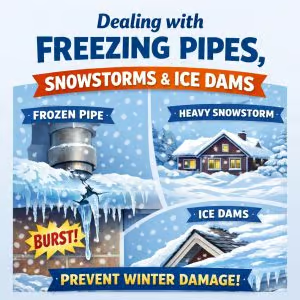
Winter Storm Alert: With a significant snowstorm and extreme cold in the forecast, now is the perfect time to protect our homes and businesses from winter weather damage.


In an attempt to stay ahead of common cold weather risks such as frozen pipes, ice dams and more, we offer:

Freezing Weather Preparation Tips

Consider sharing the following reminders with our customers:

  • Keep thermostat settings consistent – never below 55°F
  • Open cabinet doors to allow warm air to circulate around pipes
  • Let faucets drip slowly during extreme cold
  • Insulate exposed pipes in basements, garages, and crawlspaces
  • Know where the main water shut off valve is located
  • Clear snow and ice from roof edges to help minimize ice dams

Ice Dams

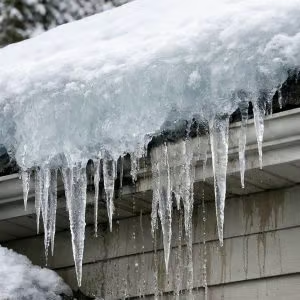
An ice dam is an accumulation of ice at the lower edge of a sloped roof, usually at the gutter. When interior heat melts the snow on the roof, the water will run down and refreeze at the roof’s edge, where temperatures are much cooler. Eventually, the ice builds up and blocks water from draining off of the roof. This, in turn, forces the water under the roof covering and into your attic or down the inside walls of your house. Once an ice dam forms, the potential damage can be serious.

Taking the following steps will decrease the likelihood that ice dams will form or, at least, will reduce their severity.

  • Keep the attic well ventilated. The colder the attic, the less melting and refreezing on the roof.
  • Keep the attic floor well insulated to minimize the amount of heat rising through the attic from within the house.

As an extra precaution against roof leaks in case ice dams do form, install a water repellent membrane under your roof covering.

Unfortunately, ice dams may be unavoidable if your home has recessed lighting near the roof. Heat generated from these lights melts snow which then contributes to ice dam buildup. The only sure way to avoid this problem is to eliminate recessed light fixtures near the roof.

Freezing Pipes

Frozen water in pipes can cause water pressure buildup between the ice blockage and the closed faucet at the end of a pipe which leads to pipes bursting at their weakest point. Pipes in attics, crawl spaces and outside walls are particularly vulnerable to freezing in extremely cold weather. Holes in outside walls for TV, cable or telephone lines allow cold air to enter the house.

To keep water in pipes from freezing, take the following precautions:

  • Fit exposed pipes with insulation sleeves or wrapping to slow the heat transfer. The more insulation the better.
  • Seal cracks and holes in outside walls and foundations near water pipes with caulking
  • Keep cabinet doors open during cold spells to allow warm air to circulate around pipes, particularly in the kitchen and bathroom.
  • Keep a slow trickle of water flowing through faucets connected to pipes that run through an unheated or unprotected space. Drain the water system especially if your house will be unattended during cold periods.

Stand-Alone Jewelry Coverage

Stand-Alone Jewelry Coverage


Over the past few years, we’ve reached a clear conclusion: for most clients, it makes far more sense to insure valuable jewelry on a separate, stand‑alone policy rather than adding it to a homeowners or condo policy.

This isn’t a theoretical recommendation. It’s based on real pricing, real claims, and real renewal outcomes we’ve seen again and again. Here’s why many clients choose to separate jewelry coverage from their home insurance.


1. The Cost Difference Is Significant

In our experience, insuring jewelry through a dedicated jewelry insurer like BriteCo is often 30–40% less expensive than scheduling the same items on a homeowners or condo policy.

Why the savings?

  • Jewelry specialists price coverage specifically for fine jewelry, rather than bundling it into a broader home policy.
  • Coverage is typically written on an agreed‑value basis, so there’s no depreciation or guesswork at claim time.
  • Jewelry policies don’t carry the same built‑in risk load that home policies do for non‑jewelry losses.

The result: lower premiums, clearer pricing, and fewer surprises.


2. How the Coverage Compares

In most cases, stand-alone jewelry policies provide coverage that is very similar to what you’d receive by scheduling jewelry on a homeowners or condo policy.

Coverage typically includes:

  • Theft
  • Accidental damage
  • Mysterious disappearance
  • Worldwide protection

In other words, moving jewelry to a separate policy is usually not about expanding coverage or insuring against new types of losses. The core protections are largely the same.

Where the difference shows up is not in what is covered, but in how the coverage is priced, administered, and how claims impact your overall insurance profile.


3. Protecting Your Home Policy Matters More Than Ever

This is the reason we feel most strongly about.

Insurance companies closely review claim history at every renewal. Even a single jewelry claim—especially a theft or mysterious disappearance—can lead to:

  • Increased homeowners premiums
  • Loss of preferred pricing or discounts
  • Placement with a less desirable carrier
  • In some cases, non‑renewal of the home policy

By keeping jewelry losses off your homeowners policy entirely, you’re protecting the long‑term stability of one of your most important insurance contracts.

A jewelry claim shouldn’t jeopardize your ability to insure your home.


4. Cleaner Claims History, Cleaner Renewals

Separating jewelry coverage creates a cleaner insurance profile:

  • Jewelry claims stay on the jewelry policy
  • Home claims remain limited to true property losses
  • Renewal negotiations are simpler and more predictable

In today’s tightening insurance market, this separation can make a meaningful difference.


Putting It All Together

If your jewelry is currently scheduled on your homeowners or condo policy, it’s worth revisiting that decision.

We can:

  • Review your existing jewelry coverage
  • Re‑rate it with BriteCo
  • Show you the cost and coverage differences side by side

In many cases, clients save money and reduce risk to their home policy at the same time.

If you still have jewelry insured on your home policy, give us a call. We’ll walk you through your options—and help you protect both your valuables and your homeowners insurance.

Prevent Frozen Pipes This Massachusetts Winter

FROZEN PIPES PREEVENTION

Massachusetts winters bring freezing temperatures—and a major spike in frozen pipe and water-damage claims. A burst pipe can release hundreds of gallons of water an hour, causing serious damage that is often preventable.

Here’s what homeowners should do when temperatures plummet:

Top Tips to Prevent Frozen Pipes

  • Keep heat at 70°F or higher, even when away.

  • Let faucets drip to keep water moving.

  • Open cabinet doors under sinks to let warm air reach the plumbing.

  • Insulate exposed pipes in basements, garages, attics, and crawl spaces.

  • Shut off and drain exterior faucets (even freeze-proof ones).

  • Seal cold-air leaks around pipes, wiring, and foundations.

  • Consider smart leak detectors or temperature monitors, especially for second homes or vacations.

If You Leave for Vacation

  • Keep the heat on (65–70°F).

  • Shut off the main water supply.

  • Have someone check the house regularly.

A few simple steps now can prevent thousands of dollars in damage later.

If you’d like personalized winter-prep advice or want to review your home policy, Johnson & Rohan Insurance is here to help.

Winter Driving Tips

Winter Driving Tips


Here it is, early December and Massachusetts has received our first taste of winter. Following are our winter driving tips:

Beware of snow banks! Go slow when pulling in and out of parking lots or side streets. Drive slow, in general, because you can’t see vehicles driving in and out of parking lots and side streets. Road are narrower and driving more harrowing. Be careful.

Be prepared.  Have your mechanic check your car’s battery, brakes, fluid levels and tire wear.  Keep your gas tank more than half full- it lowers the chance of freezing and you’ll also avoid running out of gas if your stuck in a traffic jam on 128.

Take care in pulling out.  Your car reacts differently to accelerating on snow, make sure there is plenty of time/space to get your car up to speed.  Remember other vehicles may have trouble braking because of the conditions.

Back your car into the driveway when possible.  You’ll have better vision when pulling out.

Be aware of walkers or joggers on the street. When sidewalks are impassable, die hard joggers and dog walkers are forced to venture onto the street for a clearer path.   Keep an eye out for them!

When waiting to make a left hand turn, keep the wheels of your car pointed forward.  If your wheels are turned to the left and you are rear-ended, your car will be pushed into the path of on-coming traffic.

Braking.  If your car does not have anti-lock brakes and you start to skid, pump the brakes to gain control of the skidding.  If your car has anti-lock brakes, slam and hold down the brakes to allow the anti-lock system to take over.

When you must travel during a storm, notify others of your estimated time of arrival and your intended route.

If stuck, stay in the car and wait for help.  Run the engine and heater sparingly.  Also make your exhaust pipe is clear from snow and ventilate your car to prevent carbon monoxide build up.

If stuck in a storm, preserve your energy.  Have food (energy bars, trail mix, beef jerky) in your car.   They will provide your body with energy to produce its own heat.  Have water available to prevent dehydration.  Don’t eat snow, it lowers your body temperature- if necessary, melt it first.

Prepare a Winter Driving Kit and leave it in your trunk.  Your kit should include an extra pair of gloves, blankets, an ice scraper, food basics (energy bars, trail mix or beef jerky work well), water or energy drink.  An affordable car battery- air compressor can provide a battery charge or refill a flat tire.

Driver New to Winter Driving?  Find an open location with wintry conditions and let the inexperienced driver practice accelerating and braking on snow.  Your car will behave differently on snow and ice and a little practice can make a big difference.

Turkey Talk


Let’s talk turkey,  as in: Happy Thanksgiving!

Our office will be closed on Thursday, November 27th through Friday, November 28th to celebrate our favorite holiday: Thanksgiving!

From our family to your family, we wish you only the best of this Holiday Season.

Thank you for insuring with our insurance agency.

If you are reporting a claim during off hours you can do so directly, have your policy number ready and call or click:

Travelers: 1-800-252-4633
Safety Insurance: 800-951-2100
Vermont Mutual: 1-800-435-0397

Plymouth Rock: (Auto) claims: 833-511-7635, (Home) 844-346-1225
Mass Property: 1-800-392-6108
Progressive Insurance: 1-800-274-4499
Bristol-West: 1-800-272-7865
Swyfft Insurance: 1-877-799-3389
Hagerty Insurance: 1-877-922-9701
Utica First Insurance: 1-800-456-2139
MAPFRE/Commerce: 1-866-351-2548
Grundy Insurance: 866-338-4006